Showing posts with label Harriette Tsosie. Show all posts

Friday, May 9, 2014

Opening of "Honoring Our Ancestors" at Gaucho Blue Fine Art Gallery, Penasco, NM

Some memories of long ago shimmer with a golden glow than makes one wonder if they really happened. The April 19 opening of the Creation Migration "Honoring Our Ancestors" was such an event. It has that glow already, even though it just happened a few weeks ago. It was a well attended, well received and long to be remembered special event for the project artists as well as the community at large.

Blessing Place

The ancestral "Blessing Place", a collaboration created by the artists for this exhibit, was the center "stage" for the opening ceremonies. Symbolic articles were added to the piece to be inclusive of the major cultural and religious foundations of the region: Picuris, Spanish, Catholic, Jewish, Protestant, Ugandan, as well as a range of symbols making it's representation more widespread, even universal.


In this chapel-like setting  we were honored by a blessing from Picuris Elder, Cat Tsosie. The buffalo skull was loaned for this exhibit by Cat, and later in the event he presented a talk about "Buffalo" as a meaningful symbol in the lives of his Pueblo, as well as for Native Americans in general. With his natural mix of humor and the sacred, Cat brought many gifts to this special event.


Cat Tsosie


In order to honor the elders from  the local communities, we chose the oldest person from several of the High Road villages. Jerol Arguello, historian, and Miguel Torres of the New Mexico DNA Project greeted the elders or their representative family members. The elders honored for this event, from the eldest to the youngest, were as follows: Lucia Lopez of Chamisal, age 101; Margarita Torres of Truchas, age 100; Abenicio Sanchez of Ojo Sarco, age 95; Tillie Romero of Vadito, age 95; Delia Montoya of Rodarte, age 94; Ofelia Aguilar of El Valle, age 92; Theodore Sandoval of Rio Lucio, age 92; Rudolfo Ortega of Llano de San Juan, age 91, Gabriel Gonzales of Placitas, age 91; Clara Lopez of Las Trampas, age 90 (?); and Rose Allrunner of Picuris, age 85.  Additionally, the well known and well respected community member, Armando Martinez of Penasco, passed away in December of 2013 at the age of 100 years.  We were happy to honor him and his many community contributions during this event.

Theodore Sandoval with Lugarda, his wife of 66 years
As the evening progressed Miguel Torres presented a power point and discussion about DNA. His position in the New Mexico DNA project has prepared him well in the topic.

Following Miguel's presentation Jerol Arguello, an avid researcher of his family's genetic background, told of the long trail undertaken by the early Spanish immigrants and the settling of the land grant of Las Trampas. Jerol is directly descended from these original settlers, specifically of Sephardic Jewish heritage.


Jerol Arguello honoring the elders
 Although the opening officially began at 3PM, people began arriving at 2:30 and by 3:30 the gallery was filled with artists, friends, community members, and families of the honored elders. The place was "abuzz" until closing at 7PM.

Artists from the surrounding communities submitted pieces that spoke of their ancestral stories and/or their migration to New Mexico. In addition a collection of old photographs dating back to the early 1900's is on loan from the historic collection of the Ancianos Community


Miguel Torres, NM DNA Project


Center in Chamisal.  Community and cultural histories were documented by photographs from the community at large, and by two community quilts from a Penasco quilt project of last year.

New works by each of the project artists enlarged and enhanced the issues surrounding identity and sense of place brought to life by this opportunity to "Honor Our Ancestors".

Please enjoy this selection of photos of the  project artists discussing their works and enjoying friends. Also represented are some images of the works of other community art submissions.


Harriette Tsosie with her work


Agu, Betsie, Belinda, Linda, Donna's work


In addition to the above mentioned special guests, contributors and presenters, we wish to express our deep gratitude to Gaucho Blue Fine Art Gallery owners, Nick Beason and Lise Poulsen. Their generous spirits and beautiful gallery provided a rich environment in which this project was able to flourish.

Jean Nichols of Art For the Heart provided unending support as well as the lovely roses for our elders. Thanks to Cindy Alford, Jim Martin, Deborra Berlin and Marlene Santillan for keeping the food available and beautifully presented for guests.

And special thanks to Jim Martin for the amazing photographs he took at the opening event.
We are a community after all!!

Monday, September 9, 2013

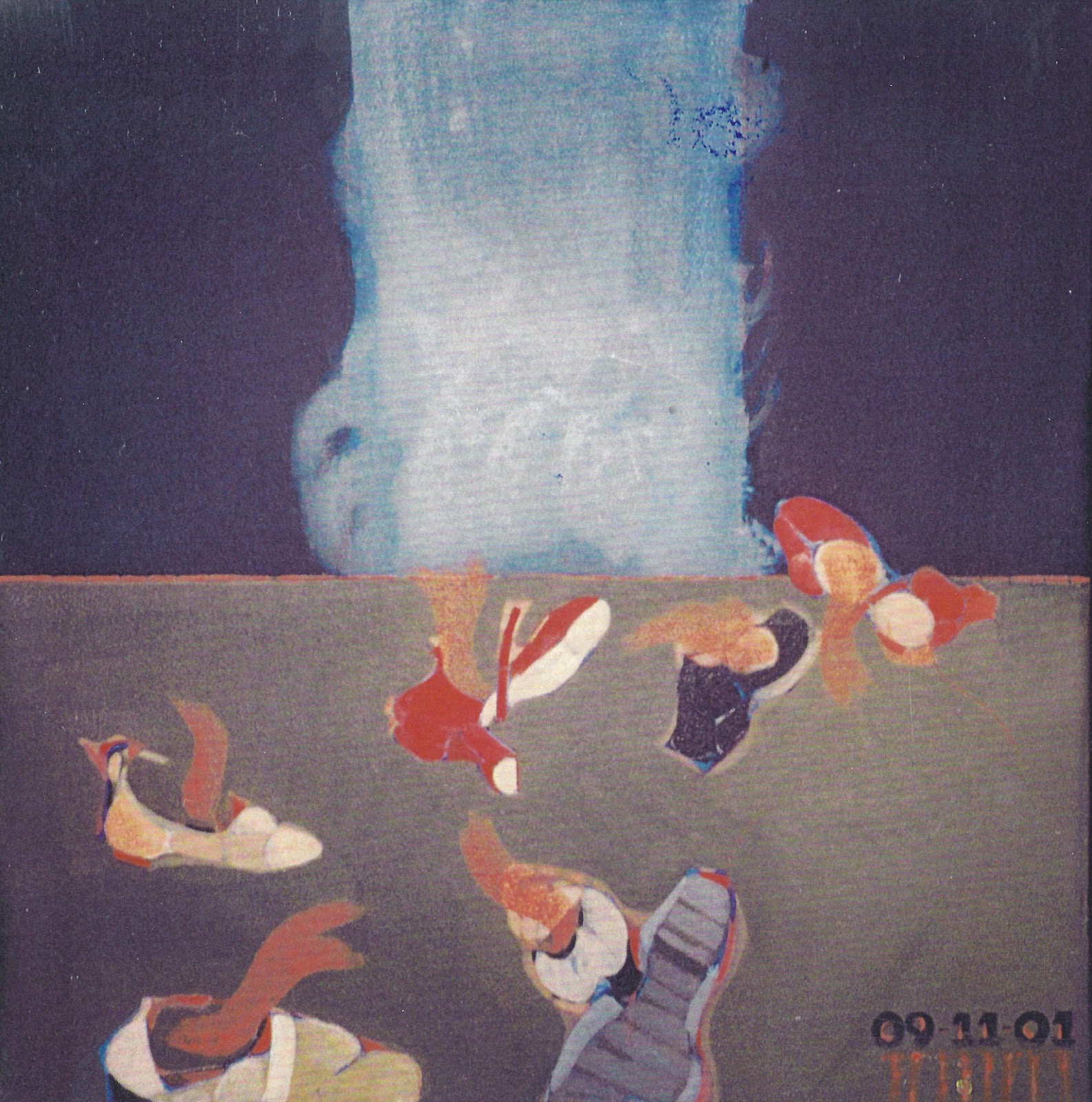
Tsosie Visits Ground Zero

9/11 AND THE NECESSITY OF ART
I remember exactly where I was and what I was doing when 9/11 happened.  I was living in a rural area in northern New Mexico off the highway leading to Los Alamos.  I had a small studio, a concrete block building with a cement floor.  It was the first actual studio I ever owned.  I didn't have a television.  Well, I had one, but it was in the closet.  I never cared much for tv, and anyway, the reception wasn't great where I was living.  So I heard about the trade center towers on the radio that I turned on every time that I went into the studio.  The announcer was detailing how terrified women were kicking off their high heeled shoes so they could run faster away from the collapsing towers.  What a powerful image. When I came home from work that evening I gathered up all my high heeled shoes and threw them on the studio floor and painted them.  The dark towers were in the background, dust and debris rising between them. I had never completed a painting so quickly.

"Vanished", acrylic on canvas, 2002, 20x20

I entered it into a juried show in Las Cruces and my husband and I drove there for the opening.  I didn't wear a name tag.  I wanted to be anonymous.  I wanted to watch the reactions of the viewers.  I got what I came for when a woman looked at the painting, read the title, clutched her throat and gasped. Then we went home.

Fast forward twelve years and I am going to another opening, this one in New York. My twelve year old grandson and his mother (my daughter) are going too.

Erica and Nicholas
I am there for the museums and the galleries, but he wants to see: Ripley's Believe it or Not; the Blue Man Group; the Empire State Building; the Statue of Liberty; and yes, the World Trade Center Memorial (I'm amazed that he knows about 9/11.)  Being a good grandmother, I accommodate most of his list, knowing I can see the museums and galleries after he leaves.   I skip the Empire State Building. I don't like heights.


I am unprepared for the World Trade Center experience.
We thread our way through long lines, several security checks, and then enter a large park with many people. Very quiet people.  There are two pools. a north and a south pool (the tower footprints?)  Water cascades over the sides and disappears into a black hole, just as the victims had.


South Pool, World Trade Center Memorial, 2013

In front of the south pool stands a group of uniformed Swiss firefighters, silently paying their respects to their fallen comrades.  In the background is a slanted museum building which will open in 2014.

Swiss firefighters    


 Growing in a special place within the park is the "Survivor Tree".  The tree had been near ground zero and was badly decimated by the falling debris.  A local nurseryman rescued it and nursed it back to health, only to have it fall victim to a vicious storm later on.  It survived a second time.  People line up to stroke it.

Daughter Kathy and The Survivor Tree
 
I'm not a particularly sentimental or patriotic person, but I am deeply moved by this experience. I think of the artist's mind, which understood metaphor so well; the respect the artist held for those who would view the work; the collaboration that occurred with the engineers and the builders.

Tsosie on Brooklyn Bridge; financial district in background


I came away with renewed appreciation for all of us who call ourselves artists and attempt to memorialize the the human experience, the spiritual aspects of our lives.  Painting is not dead and art is just as necessary as it always was and always will be.

New World Trade Center

Thursday, August 29, 2013

Faces of Personal "Herstory": A Collaboration

During much of this summer (2013) the Creation/Migration project has exhibited a shared art piece that lends itself well to the discussion of process in the development of collaborative artworks. The exhibit has been at the Esther Bone Library Gallery in Rio Rancho, NM. During the planning phases we knew we would be presenting the exhibit in a library setting.


In consideration of the tradition of historic figures being seen in libraries in the format of cast busts on pedestals, we decided to repeat the essence of this idea.  Each of the four artists in our group created a personage that is representative of some part of her Creation/Migration story.  Besides being thematically tied together, that connection was enhanced by having each persona also represent one of the ancient elements: Earth, Air, Fire and Water.


In the above photograph, on the far left in the grouping, is Harriette Tsosie's piece, "A Secret".  The cat has multiple meanings for Harriette as evidenced by the CAT symbols in her life, from Harriette's love of cats, to her love of a very particular CAT, and, by the way, note the catty expression on Harriette's cast face!

The simulated bronze finish is created through the expression of FIRE, as are the cast bronze figures of tradition.  Harriette's medium of encaustic paint utilizes the heat-melted wax to produce her surface effects and coloration, bringing the transformative affect of fire to each piece.


The WATER element (second from left) is brought to life in Belinda Edward's depiction of her ancestral figure. This woman speaks of the essence of her long journey from Africa. Her skin is reminiscent of underwater ripples, of whale or seal hide, of fishing nets; covered with shells and barnacles and clothing that seems more like delicate translucent jelly fish or kelp flowers, bringing the true essence of the ancient wisdom of the ocean's secrets.

And more secrets are held in the shell-studded medicine bag that dangles from her neck and the wand of life-giving messages from the nestings of sea birds, as though carried on the winds of the sea.


Perchta of the Alpine Forest (third from left) is Donna Caulton's tribute to her ancestry and to the EARTH element. Although her bearing is regal as the pagan goddess she represents, she is  revered and feared and as earthy as a goddess can be.

Donna has many Berthas in her German matrilineal line, but the namesake is unknown.  Perchta (an ancient name from which Bertha was derived), then, became Caulton's chosen namesake to represent the earth elements of her female ancestry.

Perchta has many faces, but the one depicted here is the goddess of weaving and guardian of the beasts. She was known to wander through the winter forests, always with spindle in hand, always watchful of the safety of the herd animals (and little children).  People were careful to leave food out for her on the cold winter nights, staying in her good graces, never willing to risk her fearful dark side, one that all pagan gods and goddesses were known to possess.


On the far right is Betsie Miller-
Kusz representation of her far matrilineal roots in Ethiopa and her near self in the Jemez Mountains of northern New Mexico.  Both are grounded in and born of earth, but carried into the present on the AIR; a seed landing here, taking root; landing there, taking root; finding herself on the path of the true sojourner.

It is a rare month that goes by that does not find Betsie in an airplane, making a landing  at one of her many points of transformation.


Each artist in this project is strongly grounded in the EARTH element.  Each of the four, however, has varying depths in the other three ancient elements; fire, water and air. Perhaps it is the earth element that allows this group to function so well within the collaborative process?

Please join us as we explore this question, among others, as panel presenters at the 2013 EncaustiCon conference this November (2013) in Santa Fe, NM.
http://www.encausticon.com/presenters

Sunday, January 13, 2013

Harriette Tsosie: Creative Journey


The winter 2012 edition of Encaustic Arts Magazine, featuring Harriette Tsosie's work on the cover, also has an in-depth article describing some of the steps along the pathway of  Harriette's journey in art-making.
The images and full text appear below:

HARRIETTE TSOSIE; CREATIVE JOURNEY

The Mentor and the Medium

Like most artists who work with wax, I was already working in another medium when I discovered encaustic.  I had studied acrylic painting with jules Kirschenbaum, a New York artist who was "in-residence" at Drake University (Des Moines, IA) when my then sposue accepted a faculty position there. 

As a faculty wife I was able to take classes without paying tuition. I enrolled in Jules' courses repeat­edly, fully embracing the master/ apprentice relationship. We not only painted, we read and discussed books he assigned. (Mine was Celine's existential Journey to the End of the Night). More than how to paint, Jules showed us how to live as artists. He encouraged our intellectual curiosity. I think most artists have had a mentor like Jules sometime during their creative journeys. Without one, the journey is lonely and difficult.
Moving to the Land of Enchantment
I moved to New Mexico in 1995 and soon bought a small house in a rural area. After Iowa's gloomy interior light, New Mexico made my eyes happy. I was surrounded by beautiful landscapes and fasci­nating cultures. For the first time, I had dedicated studio space--a small concrete block building on the property --and time to paint on the weekends. (I worked full time until 2003).

"Wandering" (detail from"Migration"), Acrylic

I continued painting with layers of acrylic washes, as Jules had taught me. The layers gave both physical and psychological depth to the work. I liked that. I didn't want to do work devoid of meaning. I saw painting as wordless communica­tion, believing that recognizable images commu­nicated more powerfully than abstract ones. By working in a series, I explored my subjects from multiple perspectives. "Migration" was the first series of acrylic paintings I completed after coming to New Mexico. It was based on a piece of music by Carlos Nakai and Peter Kater. It included twelve 12" x 12" canvases, referencing the movements of their work.

Encountering Encaustic

A young artist --Shawna Moore-- moved in next door and befriended me. She took an encaustic workshop from Santa Fe painter Ellen Koment (Encaustic Arts Magazine, Summer 2012 issue). I had never heard of encaustic, but I loved the paintings Shawna made with it. They had layers. There could be series. I took the workshop.

Glyph #5, Acrylic
 In 2004 I married a Native American man I had been dating and moved to his pueblo. He built me an incredible studio, looking out on the mountains. For a while I continued painting with acrylic, completing a series on baskets, then one on petro­glyphs. The baskets referenced aspects of my life and psyche such as the Native ceremonies. I felt they were alive. The petroglyph series inspired a pilgrimage to California's Little Petroglyph Canyon for a firsthand look at the ancient images pecked in rock. I dreamed they came to life at night, left the rocks, and moved around. My husband's culture continues to influence me profoundly.
Techniques I practiced with acrylic served me well as I began working with encaustic. Layering the wax felt natural.  I loved the immediacy of the torch, the very idea of playing with fire. Since I had been trained to paint representationally, (set up a still life, draw it, and then scale it up to the canvas) that is what I tried to do. Even though landscape had never been my subject matter, I now lived in a landscape I couldn’t ignore. Aspens became the subject of my first encaustic series. I carved into the wax, pushing pigmented wax into the grooves to create the tree trunks, cross-hatching for the bark. Tedious! Creating images with encaustic proved difficult. Once I lit the torch, my images moved, melted, sometimes even disappeared! I was no longer in control.


"Aspens Aglow", Encaustic

Embracing Abstraction
That proved to be a good thing; a freeing thing. The longer I worked with encaustic, the more abstract my work became. My subject matter changed dramatically: alternative realities (i.e. premonitions) archetypes, symbols (particularly alchemical symbols), myth and language now captured my interest. I read Joseph Campbell and explored Alchemy: embedded older pieces of work into the wax, a technique I learned from Laura Moriarty (see “Attraction”). Today the same subject matter still attracts me and I work in these categories.


Pollen Men, Encaustic

Continuing to explore encaustic, I enrolled in an R&F workshop in Texas (Gina Adams) and took a five day monotype workshop from encaustic master painter Paula Roland in Santa Fe, adding to my skill set. Encaustic is seductive. For me the challenge has been to remain focused on content and not become distracted by the any techniques, tools, gimmicks and special effects an artist can achieve with it. 


"Alchemy", Encaustic, paper and ink

Coming Full Circle

In 2009 I moved to Albuquerque and got involved in its rich arts community.  I collaborated with other artists to produce the "Mining the Unconscious" Project (http://www.miningtheunconsious.org), a series of three exhibitions and 20 public programs unleashed in Santa Fe in 20011. The project was responsive to the long awaited publication of Carl Jung's Red Book journals. It created an ongoing dialog between the participating artists and the larger community.


"Attraction", Encaustic


"Someone Else's Reality, Encaustic
From the experience I developed a close relationship with  three other artists working in other media.  We're currently exploring identity issues through another series of exhibitions and public programs, "Creation/Migration: Stories of the Journey". We've all had or DNA analyzed through National Geographic's Genographic project. We now know the migration routes our distant ancestors took out of Africa and are further researching our respective genealogies.
We're interested in the places myth and science intersect:  do our DNA results contradict what we have believed about who we are? My work for this project is based on my paternal grandparents' diaries and love letters, which are more than 100 years old. They are a fascinating window to life in Baltimore and New York City in the early 1900s. The work will include encaustic, collage, acrylic and giclee.
The journey continues. 

For further information please visit http://www.harriettetsosieart.com


Saturday, December 1, 2012

Albuquerque's "Alibi" Captures the Essence of Creation/Migration

Thanks to Alibi's writer Leigh Hile for her wonderful review of our first exhibit. She really understands the nature of our project! Below is the article in full, reprinted from "Alibi", Nov, 29.


Gallery Review

The Long Road

Group show weaves together science and mythology

Laura Liccardi photo
Belinda Edwards says she was called to the desert. And though she almost gave up on the move to New Mexico, “A little voice said to me, Don't worry, you're coming,” she says. “I left a job. I sold my house. This is my magical place.”
Edwards, who’s from Santa Barbara, Calif., is one of four artists whose work composes the group exhibit, “Creation / Migration: Stories of the Journey” on display Downtown at the FreeStyle Gallery.
Works by (from left to right) Donna Caulton, Belinda Edwards, Harriette Tsosie, Harriette Tsosie, Donna Caulton and Belinda Edwards
Laura Liccardi photo
Works by (from left to right) Donna Caulton, Belinda Edwards, Harriette Tsosie, Harriette Tsosie, Donna Caulton and Belinda Edwards
Harriette Tsosie, Betsie Miller-Kusz and Donna Caulton—her three collaborators—share similar histories. All trace migratory paths that led them around the country and the world, eventually to converge in New Mexico. And each, like Edwards, felt drawn here by some powerful force, their spiritual odysseys reflected in literal migrations. The FreeStyle exhibit taps into this theme, mining the connection between journey and identity.
Belinda Edwards
Laura Liccardi photo
Belinda Edwards, "Origin"
The women combined their efforts to create the centerpiece of the exhibition, a large basket. Miller-Kusz's layer begins the basket with willows from her home, strips of her old paintings and clothesline like her mother and grandmother used. Filling out Tsosie’s section are palm fronds and yucca pods, which respectively represent Florida, where her parents lived the last years of their lives, and New Mexico, where she has settled. Caulton used paintings from the beginning of her career and fishing line, embodying her connection to water. Edwards’ layer finishes the basket with more yucca seeds, symbolizing life, death, rebirth and Mother Earth.
Miller-Kusz says these days, the creative process just flows. “When you get to be at this stage of life—and none of us are saying which stage that is exactly,” she adds slyly, “you just turn the faucet and it just pours right out. You don't need to worry too much about what your voice is anymore.”
“I left a job. I sold my house. This is my magical place.”
Belinda Edwards
Tsosie agrees, saying at her age, she can be who she really is, “not someone's mother, not someone's wife.”
The artists dug deep into their family histories and ancestral origins in an exploration of how the movement and stories of their predecessors have shaped their identities. To map these intricate trails, they unearthed personal memories and oral family histories. They collected artifacts from ancestors. They researched journals, letters and stories in old newspapers. They consulted family trees and genealogy websites. And, perhaps most intriguingly, they used DNA analysis to trace their deeper backgrounds.
Harriette Tsosie’s “Migration”
The show is grounded in research and hard facts. “We're not just mystical artists floating off into the netherworld,” jokes Miller-Kusz. “We all have that interest in scientific inquiry.” The interplay between legend and reality, between where we come from and where we think we come from, is at the heart of Creation / Migration. “It became a dialogue between myth and science,” explains Tsosie, “And we were interested in where myth and science met and clashed.” Ultimately, she says, maybe we don’t have to choose. “Science is sort of explaining how, and maybe the myths are explaining why.” Both questions—not one or the other—get to the truth of who we are.
The revelations about their DNA will continue to inform future incarnations of Creation / Migration—a project which, like the artists’ personal journeys, is an ever-evolving, unfolding process. Edwards, for example, discovered that she has origins in three different regions of Africa. Now she’s learning about artistic traditions in each of those cultures and comparing them to her style, hoping to explore whether her artistic expression is predetermined by genetics.
“We’re not just mystical artists floating off into the netherworld. We all have that interest in scientific inquiry.”
Betsie Miller-Krusz
But on a genetic level, like all humans, there’s little difference between the four women, who share common origins in ancient Mesopotamia. “I think that having our DNA and knowing that we all started in the same place is part of the collaboration,” says Edwards. “We're family, in a sense.” And in a project that so intimately probes the relationship between family and self, past and present, that is everything.
Creation / Migration: Stories of the JourneyRuns through Dec. 14
FreeStyle Gallery1114 Central SW

Open Thursday through Saturday, 10 a.m. to 2 p.m.
Monday and Wednesday by appointment
freestylegallery.com

Sunday, November 18, 2012

First Artist Panel: Ralph Greene Freestyle Gallery

Our first Creation/Migration Artist panel discussion happened yesterday, November 17, 2012, in the midst of the beautiful exhibit at the Ralph Greene Freestyle Gallery.  Each artist expressed her deep involvement in the exhibit, the creation/migration process, the  growth of the collaborative process, and her own genetic links. Those present were receptive, expressive and participatory.  It just could not have been a better day!!

We wish to express our deep gratitude to Ralph Greene for allowing us to exhibit in his lovely gallery space.  The venue is perfect for the feeling of intimacy and family intertwined in the intent of the artworks presented.
Besides the beautiful and intimate surroundings, Ralph has been completely supportive of and enthusiastic about the exhibit, the panel, the receptions and the concepts inherent in our project. Thank you Ralph.
Please follow as Ralph progresses through a future of interesting exhibits and events. http://www.freestylegallery.com


Group shots by Lara Liccardi

Thursday, November 15, 2012

Harriette Tsosie/Michael Billie Journey through Encaustic Workshop

Creation/Migration artist Harriette Tsosie and her colleague Michael Billie hosted a two day workshop November 10 -11 at Tsosie's South Valley Studio, Albuquerque.  Workshop participants explored eco printing, rusting, and branding with Billie on the first day.  On the second day, Billie helped students adhere their eco prints to panels using wax medium. Tsosie demonstrated special effects with encaustic and helped students create paintings, collage paper elements and incorporate graphite in their work. Pictured are the eco print bundles, boiled in walnut dye, and some of the completed encaustic paintings.


Tsosie said: "Part of the story of my own journey has been agreeing to teach the encaustic process to others. I did not initially want to do this, as I felt it would take time away from my own work.  I also feel very proprietary about my studio space: it's my personal kiva and I wasn't sure I wanted others to work there.  However, it has been a wonderful growth experience.  The teaching is reciprocal: I learn from my students."  
painting by Elise Johnston

painting by Wendy Wells

Friday, November 9, 2012

Albuquerque Welcomes CREATION/MIGRATION Exhibit 1


On opening night, November 2, 2012, the first exhibit of CREATION/MIGRATION: Stories of the Journey opened at Freestyle Gallery in Albuquerque.  There was a warm welcome from friends, art lovers, artists and the Albuquerque press.  The exhibit sparked enthusiasm as well as thoughtful contemplation for the journey we are making, our collaboration, our processes and our stories. 

The Sojourner Basket tied together so much of our process. During the creation of it, it seemed to have its own speaking voice and the stories we gave to it no longer belong to four separate artists, but to the basket and to the creation of myth.  During the opening, the viewing audience was receptive to the processes and the ideas inherent in this collaboration.


A Day of the Dead alter was an integral part of the exhibit through which we honored the journeys of our ancestors. Its intent grew in scope as Hurricane Sandy battered the east coast including many sites familiar to our families' stories. 

Travel  with us through some of our exhibit: